
Overview & Orientation
Squirrel Hill is a neighborhood in Pittsburgh’s East End, a few miles east of Downtown. The City of Pittsburgh officially divides it into two neighborhoods, Squirrel Hill North and Squirrel Hill South, but most people treat it as one place. It sits between two of the city’s largest parks, Schenley Park and Frick Park, and its main business district runs along Forbes and Murray Avenues.
Where Squirrel Hill Is
- City and county: City of Pittsburgh, Allegheny County
- Official neighborhoods: Squirrel Hill North and Squirrel Hill South
- ZIP codes: 15217 and 15232
- Neighbors: Shadyside to the north, Point Breeze to the northeast, Regent Square and Swisshelm Park to the east and southeast, Greenfield to the south and southwest, and Oakland to the west. See Wikipedia’s Squirrel Hill entry for full boundaries.
Typical Drive Times
Times are approximate and vary by where in Squirrel Hill you start. Traffic varies by time of day, and the Squirrel Hill Tunnel can back up at rush hour.
| Destination | About |
|---|---|
| Oakland | 5–10 minutes |
| Downtown Pittsburgh | 15–20 minutes |
| The Waterfront (Homestead) | 10–15 minutes |
| Monroeville | 20–25 minutes |
| Pittsburgh International Airport | 30–40 minutes |
A Brief History
The neighborhood was most likely named for the many gray squirrels in its woods. European settlement began after the French and Indian War, and land claims became official when Pennsylvania opened a land office in Pittsburgh in 1769. Two of the oldest homes in the area, the Ambrose Newton home (1760s) and the Robert Neill log house (1780s), stand in what is now Schenley Park.
Until the late 1800s, Squirrel Hill was mostly farmland with a few coal mines. Pittsburgh annexed Peebles Township, which included Squirrel Hill, in 1868. Farms gave way to country estates, which were later divided into residential lots.
Electric trolleys arrived in 1893, running on Forbes and Murray Avenues, and the neighborhood grew quickly. The Boulevard of the Allies (1927) gave a direct route Downtown, and the Parkway and Squirrel Hill Tunnel opened in 1953. By the 1930s, most of the land was built out. The Squirrel Hill Historical Society has much more.
Notable Landmarks
- Frick Park: 644 acres of wooded valleys and trails on the neighborhood’s eastern side
- Schenley Park: 456 acres on the western side, shared with Oakland and Greenfield
- Forbes and Murray business district: The neighborhood’s commercial center
- Squirrel Hill Tunnel: Carries I-376 under the neighborhood near Frick Park
Housing & Real Estate
Housing Stock
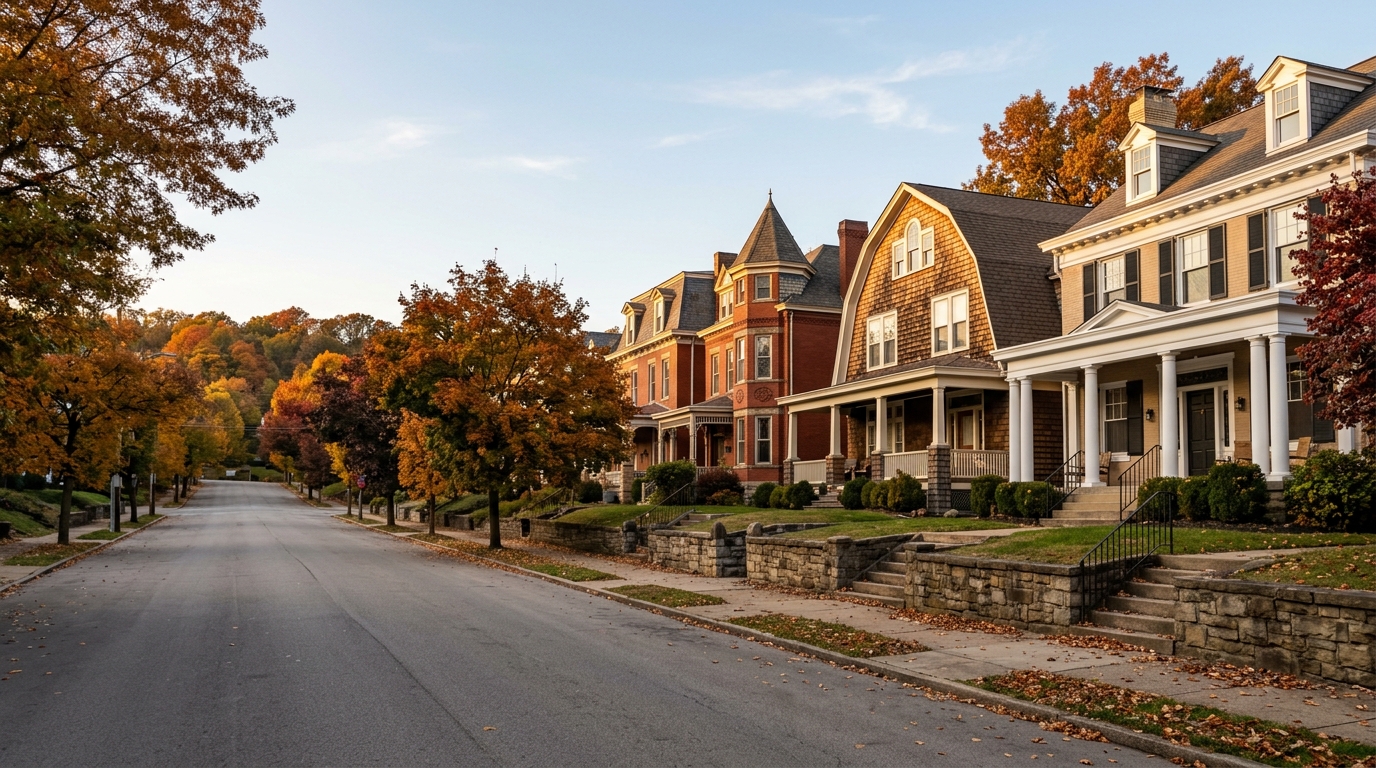
Much of Squirrel Hill was built between the 1890s and the 1930s, after the trolley lines arrived. Architectural styles from that era include:
- Queen Anne
- Colonial Revival
- Second Empire
- Shingle style
Streets are hilly in many places, and lot sizes and home styles change from block to block. Older homes may have original features, so a careful inspection is worth the time.
Types of Homes
- Single-family homes
- Duplexes and multi-unit homes
- Apartments and condominiums, especially near the business district
Prices and availability change daily, so the live feed is the place to check. See current homes for sale in Squirrel Hill.
Schools
Public Schools
Squirrel Hill is served by Pittsburgh Public Schools. Neighborhood school assignment follows the district’s feeder pattern and depends on the exact address. The district also runs magnet programs that accept applicants citywide.
- In the neighborhood: Pittsburgh Minadeo (elementary), Pittsburgh Colfax K–8, and Pittsburgh Allderdice High School, which opened in 1927
- Feeder schools: Check the district’s school finder or the city’s feeder pattern boundaries for a specific address
Colleges & Universities
- Chatham University, on Woodland Road
- Carnegie Mellon University and the University of Pittsburgh in neighboring Oakland
- Carlow University and Duquesne University, a short drive away
For school performance data, visit the Pennsylvania Department of Education’s Future Ready PA Index and the district’s own website. School assignments can change. Confirm directly with the district.
Getting Around
Major Roads
- I-376 (Parkway East): Exit 74 connects to Beechwood Boulevard at Forward Avenue. Forward Avenue leads north to Murray Avenue, and Beechwood Boulevard heads south toward Homestead.
- Forbes Avenue: The main east–west route, connecting west to Oakland and Downtown
- Murray Avenue: The main north–south business street
- Beechwood Boulevard and Boulevard of the Allies: Scenic routes along the parks and toward Downtown
Public Transit
Pittsburgh Regional Transit (PRT) buses serve the neighborhood. Routes stopping near Forbes and Murray include the 61A, 61B, 61C, 61D, 64, 65, and 74. Check the PRT trip planner for current schedules.
Walkability & Bikeability
The business district is walkable, and many errands can be done on foot. See Walk Score for Squirrel Hill North and Squirrel Hill South for walking, transit, and bike ratings.
Things to Do
Frick Park
Frick Park covers 644 acres, from Point Breeze down to the Monongahela River. Henry Clay Frick left the first 151 acres to the city in 1919, and the park opened in 1927. Highlights include:
- Hiking and biking trails through wooded valleys, including the restored Nine Mile Run stream valley
- The Blue Slide Playground, with a concrete slide built into a hillside
- Red clay tennis courts, ballfields, and Pennsylvania’s only public lawn bowling green
- Clayton Hill, a birding spot with more than 100 recorded species
- The Frick Environmental Center at 2005 Beechwood Boulevard, opened in 2016 and certified LEED Platinum
Schenley Park
Schenley Park covers 456 acres between Squirrel Hill, Oakland, and Greenfield. It has the Schenley Oval, with 13 tennis courts, a running track, and a soccer field. It also has an ice skating rink, a public pool, the Bob O’Connor Golf Course, Panther Hollow Lake, and Flagstaff Hill, which hosts summer outdoor movies. Phipps Conservatory, built in 1893, is at the park’s Oakland edge.
Annual Events
The Squirrel Hill Night Market fills three blocks of Murray Avenue, from Forbes to Beacon, with more than 100 tents of handmade goods, local food, food trucks, and live entertainment. In 2026, markets were held in late summer and early fall from 6 to 10 p.m. Check the community calendar for upcoming dates.
Shopping & Dining
Locals call the Forbes and Murray business district “upstreet,” short for “up the street.” It has more than 400 business locations, including restaurants, cafés, bakeries, shops, banks, and medical offices. The Waterfront shopping area in Homestead is a short drive south.
Library
The Carnegie Library of Pittsburgh – Squirrel Hill branch is at the corner of Forbes and Murray Avenues. It has public computers, free Wi-Fi, meeting rooms, an outdoor courtyard, a seasonal community garden, and an art gallery.
Local Services & Resources
City of Pittsburgh Services
As a city neighborhood, Squirrel Hill gets its services from the City of Pittsburgh. For non-emergency requests, such as missed trash pickup, potholes, or streetlights, contact Pittsburgh 311.
- Trash and recycling: Collected by the city. Check the city website or 311 for your collection day and recycling schedule.
- Snow removal and street services: City Department of Public Works, through 311
- Community organization: The Squirrel Hill Urban Coalition, 5604 Solway Street, (412) 422-7666, has worked on neighborhood issues for more than 50 years
Emergency Services
- Emergencies: Call 911
- Police, fire, and EMS: Provided by the City of Pittsburgh’s Bureau of Police, Bureau of Fire, and Pittsburgh EMS. For non-emergency questions, start with 311.
Hospitals
- UPMC Shadyside, just to the north
- UPMC Presbyterian and UPMC Children’s Hospital of Pittsburgh, a short drive away
Permits & Zoning
Planning a renovation, addition, deck, or fence? Building and zoning permits in the city go through the Department of Permits, Licenses, and Inspections. Applications are filed online through the city’s OneStopPGH portal.
Frequently Asked Questions
Is Squirrel Hill part of the City of Pittsburgh?
Yes. Squirrel Hill is a city neighborhood in Pittsburgh’s East End. The city officially splits it into Squirrel Hill North and Squirrel Hill South.
What ZIP codes cover Squirrel Hill?
Squirrel Hill is covered by the 15217 and 15232 ZIP codes.
What school district serves Squirrel Hill?
Pittsburgh Public Schools. Assigned schools depend on the exact address, so check the district’s feeder pattern before you buy.
How did Squirrel Hill get its name?
It was most likely named for the many gray squirrels in the area’s woods.
What does “upstreet” mean in Squirrel Hill?
It is the local name for the Forbes and Murray Avenue business district, short for “up the street.”
What parks are near Squirrel Hill?
Frick Park (644 acres) borders the neighborhood on the east, and Schenley Park (456 acres) borders it on the west.
How long is the drive from Squirrel Hill to Downtown Pittsburgh?
About 15 to 20 minutes by I-376 or the Boulevard of the Allies. Traffic varies by time of day.
Where do I get a building permit in Squirrel Hill?
Through the City of Pittsburgh’s Department of Permits, Licenses, and Inspections, using the OneStopPGH online portal.
Thinking About a Move to Squirrel Hill?
Whether you are buying in Squirrel Hill or selling a home here, we’re happy to answer questions. No pressure. Just local knowledge. Start with the current Squirrel Hill listings, or reach out to our team.
Mike Pastor Group | Realty ONE Group Landmark
412-214-9494 | pittsburghhometeam.com
Explore Nearby Communities
- Shadyside (homes for sale)
- Point Breeze (homes for sale)
- Greenfield (homes for sale)
- Regent Square (homes for sale)
- Swissvale (homes for sale)
- Edgewood (homes for sale)
Written by Mike Pastor, Team Leader, Mike Pastor Group | Realty ONE Group Landmark | PA License RS328638
120+ five-star client reviews.